> ## Documentation Index
> Fetch the complete documentation index at: https://docs.kubestacks.com/llms.txt
> Use this file to discover all available pages before exploring further.
# Finding things
> Jump anywhere with the command palette, and narrow any list by health, text or labels.
Two habits cover most of it: press ⌘K to go anywhere, and press / to filter the list you're on. On Windows and Linux, use Ctrl instead of ⌘.
## The command palette
Press ⌘K (or click **Search…** in the header) and type. Case doesn't matter. Views and commands match when every word you type appears in them, in any order, so `vol cl` finds Volume Claims. Objects match when their name contains what you typed.
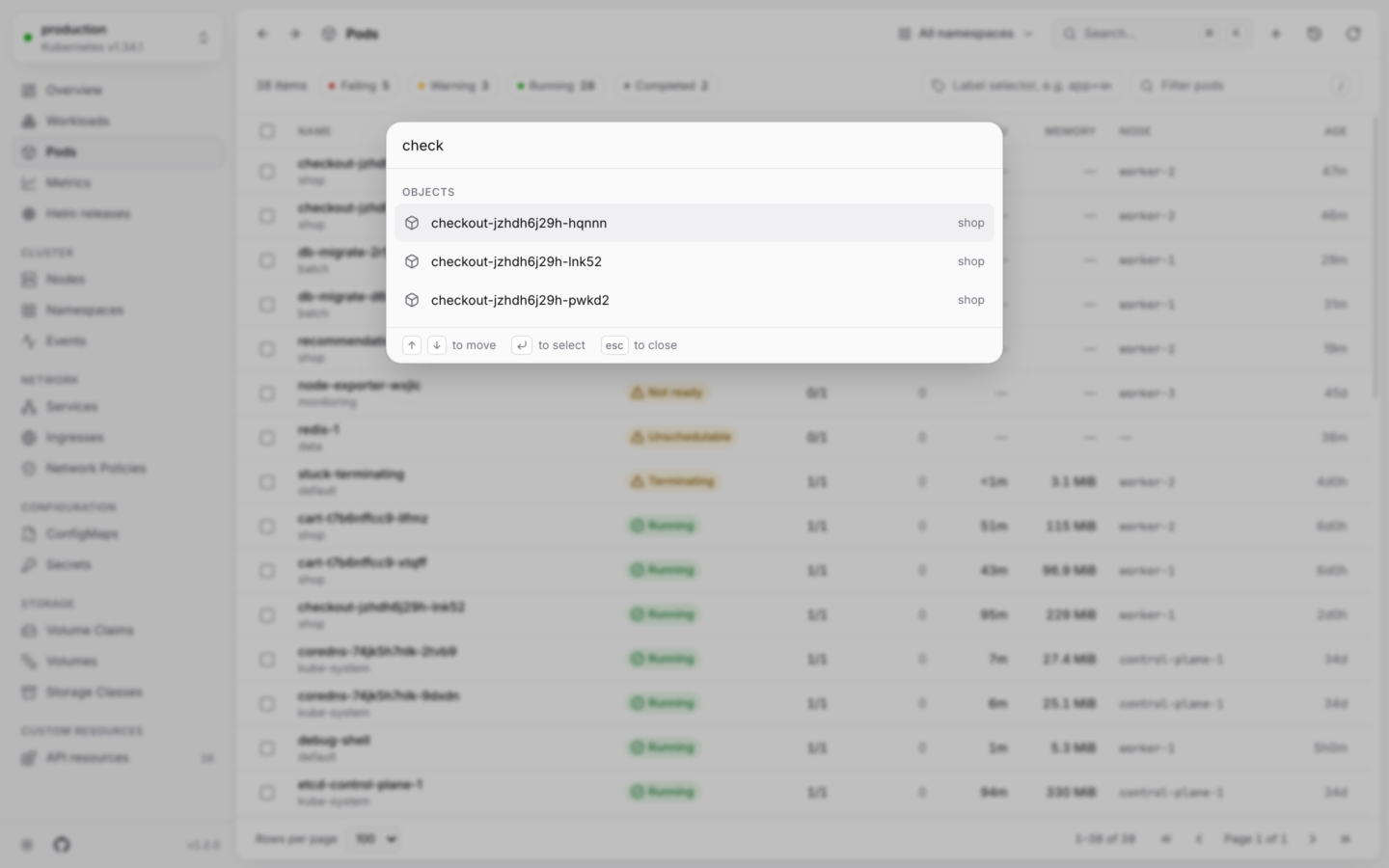
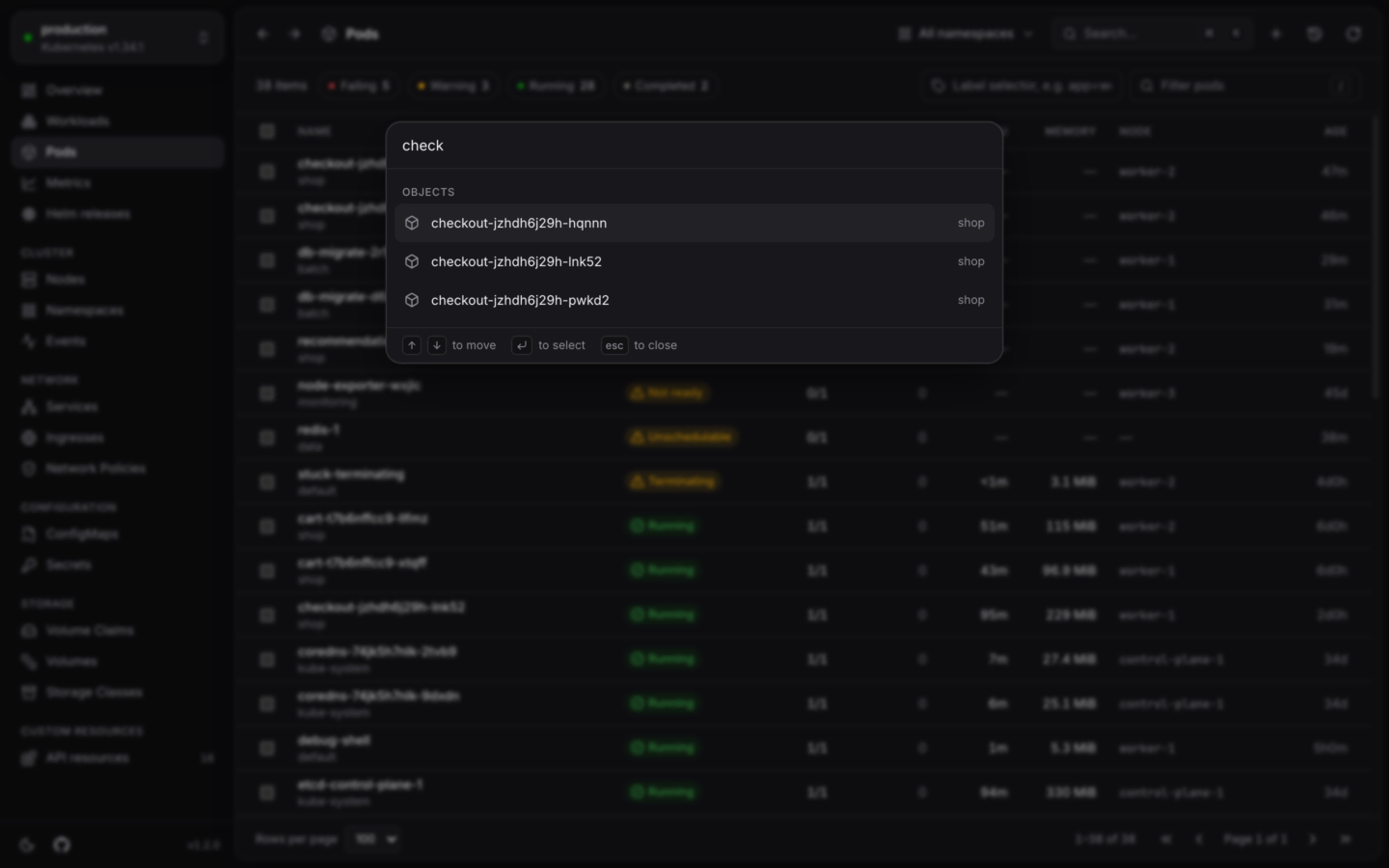 Results come in groups:
| Group | What's in it |
| - | - |
| **Actions** | When an object is open: everything you can do to it. Actions you can't take are shown, disabled. |
| **Objects** | Once you've typed two characters: objects whose names match, among those KubeStacks has already loaded in this cluster (up to 20). |
| **Go to** | Every view: the overview, Workloads, Metrics, Helm releases, API resources, and every kind the cluster serves, found by name, kind, short name or API group. Custom resources included. |
| **Namespace** | **All namespaces**, and every namespace. |
| **Clusters** | Every cluster in your kubeconfig, and **All clusters**. Desktop app only. |
| **Help & appearance** | **Create from YAML**, **Metrics source…**, **Keyboard shortcuts**, the light, dark and system themes, and making this cluster read-only or allowing changes again. |
Move with ↑ ↓, press ↵ to pick, and Esc to close.
Some views answer to other words too: `prometheus` or `usage history` finds Metrics, `charts` finds Helm releases, and `crds` finds API resources.
## Go-to keys
Every main view has a two-key shortcut: press G, then a letter, within about a second. For example G P for Pods, G D for Deployments. The sidebar shows each view's keys when you hover it, and [Keyboard shortcuts](/reference/keyboard-shortcuts) lists them all.
## Narrowing a list
Every list has the same three tools above it.
### Health
The chips count each [health level](/explore/health) in the list: **Failing**, **Warning**, **In progress**, **Healthy**, **Inactive** (some kinds use their own words, like **Running** for pods). Click one to show only those, and click more to add them. Click it again to clear it.
### Filter
Press /, or click the filter box, and type. It matches, without case:
* names and namespaces
* labels, written as `key=value`, like `app=checkout`
* for events, the reason, message and object's name
* for custom resources, what the list's columns show
On the Workloads page, the filter also matches each workload's kind and images.
↓ moves from the filter into the list. Esc leaves the filter.
### Label selector
The label selector is sent to the cluster, which does the filtering, so it's the way to narrow lists in big clusters. It takes Kubernetes' own syntax; press ↵ to apply it.
```text theme={"theme":{"light":"github-light","dark":"github-dark-default"}}
app=web
app=web,tier!=cache
environment in (staging, production)
!canary
```
A list stops at 5,000 objects (or `KUBESTACKS_MAX_LIST_ITEMS`). When there are more, it says so, with **Filter by label**, because a selector lets the cluster send only the ones you want.
## Sorting and pages
* **Sort** by clicking a column's header, and again to reverse it. Lists start sorted by status, the most urgent first; kinds with no status by name, and events by when they were last seen.
* **Pages** hold 100 rows, or 50, 250 or 500 (**Rows per page**). Use ← → for the previous and next page.
## Moving through a list
| Keys | Does |
| - | - |
| ↑ ↓, or J K | Move through the rows |
| Home End | First and last row |
| PgUp PgDn | Ten rows at a time |
| ↵ | Open the row |
| X, ⇧X | Select the row, or a range |
| ⌘A | Select every row on the page |
| Esc | Clear the selection, then close the panel |
## Back and Forward
The filter, health chips, label selector, sort, page and the open object are all part of the page's address. **Back** (⌘\[ or Alt←) and **Forward** (⌘] or Alt→) bring each of them back, like in a browser.
**In your cluster:** these addresses are real links. Copy one from the address bar to share a filtered list, or an open pod, with a teammate.
Every shortcut, in one place.
Act on the rows you've picked.
This documentation is built and hosted on [Mintlify](https://mintlify.com), a developer documentation platform.
Results come in groups:
| Group | What's in it |
| - | - |
| **Actions** | When an object is open: everything you can do to it. Actions you can't take are shown, disabled. |
| **Objects** | Once you've typed two characters: objects whose names match, among those KubeStacks has already loaded in this cluster (up to 20). |
| **Go to** | Every view: the overview, Workloads, Metrics, Helm releases, API resources, and every kind the cluster serves, found by name, kind, short name or API group. Custom resources included. |
| **Namespace** | **All namespaces**, and every namespace. |
| **Clusters** | Every cluster in your kubeconfig, and **All clusters**. Desktop app only. |
| **Help & appearance** | **Create from YAML**, **Metrics source…**, **Keyboard shortcuts**, the light, dark and system themes, and making this cluster read-only or allowing changes again. |
Move with ↑ ↓, press ↵ to pick, and Esc to close.
Some views answer to other words too: `prometheus` or `usage history` finds Metrics, `charts` finds Helm releases, and `crds` finds API resources.
## Go-to keys
Every main view has a two-key shortcut: press G, then a letter, within about a second. For example G P for Pods, G D for Deployments. The sidebar shows each view's keys when you hover it, and [Keyboard shortcuts](/reference/keyboard-shortcuts) lists them all.
## Narrowing a list
Every list has the same three tools above it.
### Health
The chips count each [health level](/explore/health) in the list: **Failing**, **Warning**, **In progress**, **Healthy**, **Inactive** (some kinds use their own words, like **Running** for pods). Click one to show only those, and click more to add them. Click it again to clear it.
### Filter
Press /, or click the filter box, and type. It matches, without case:
* names and namespaces
* labels, written as `key=value`, like `app=checkout`
* for events, the reason, message and object's name
* for custom resources, what the list's columns show
On the Workloads page, the filter also matches each workload's kind and images.
↓ moves from the filter into the list. Esc leaves the filter.
### Label selector
The label selector is sent to the cluster, which does the filtering, so it's the way to narrow lists in big clusters. It takes Kubernetes' own syntax; press ↵ to apply it.
```text theme={"theme":{"light":"github-light","dark":"github-dark-default"}}
app=web
app=web,tier!=cache
environment in (staging, production)
!canary
```
A list stops at 5,000 objects (or `KUBESTACKS_MAX_LIST_ITEMS`). When there are more, it says so, with **Filter by label**, because a selector lets the cluster send only the ones you want.
## Sorting and pages
* **Sort** by clicking a column's header, and again to reverse it. Lists start sorted by status, the most urgent first; kinds with no status by name, and events by when they were last seen.
* **Pages** hold 100 rows, or 50, 250 or 500 (**Rows per page**). Use ← → for the previous and next page.
## Moving through a list
| Keys | Does |
| - | - |
| ↑ ↓, or J K | Move through the rows |
| Home End | First and last row |
| PgUp PgDn | Ten rows at a time |
| ↵ | Open the row |
| X, ⇧X | Select the row, or a range |
| ⌘A | Select every row on the page |
| Esc | Clear the selection, then close the panel |
## Back and Forward
The filter, health chips, label selector, sort, page and the open object are all part of the page's address. **Back** (⌘\[ or Alt←) and **Forward** (⌘] or Alt→) bring each of them back, like in a browser.
**In your cluster:** these addresses are real links. Copy one from the address bar to share a filtered list, or an open pod, with a teammate.
Every shortcut, in one place.
Act on the rows you've picked.
This documentation is built and hosted on [Mintlify](https://mintlify.com), a developer documentation platform.