

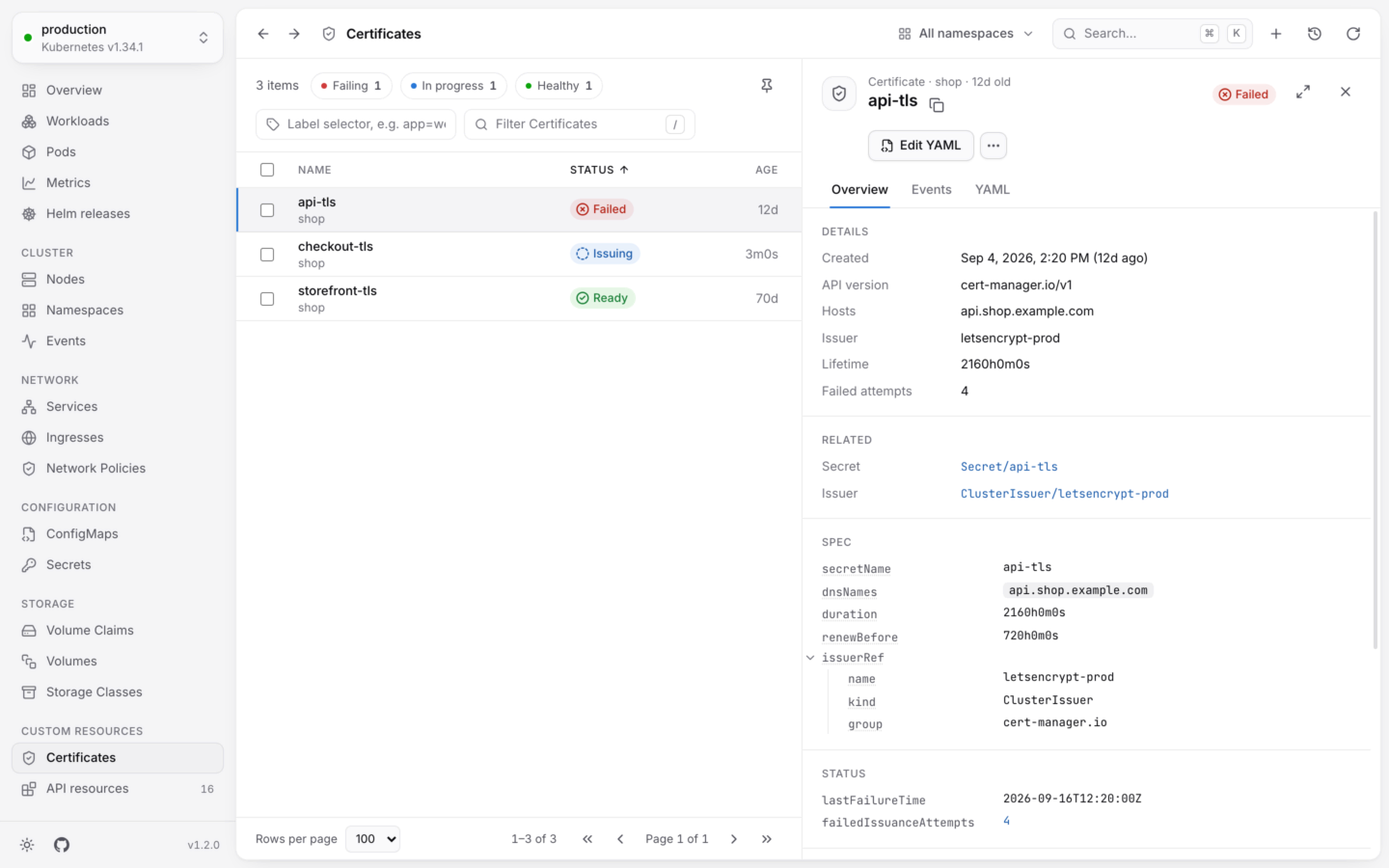
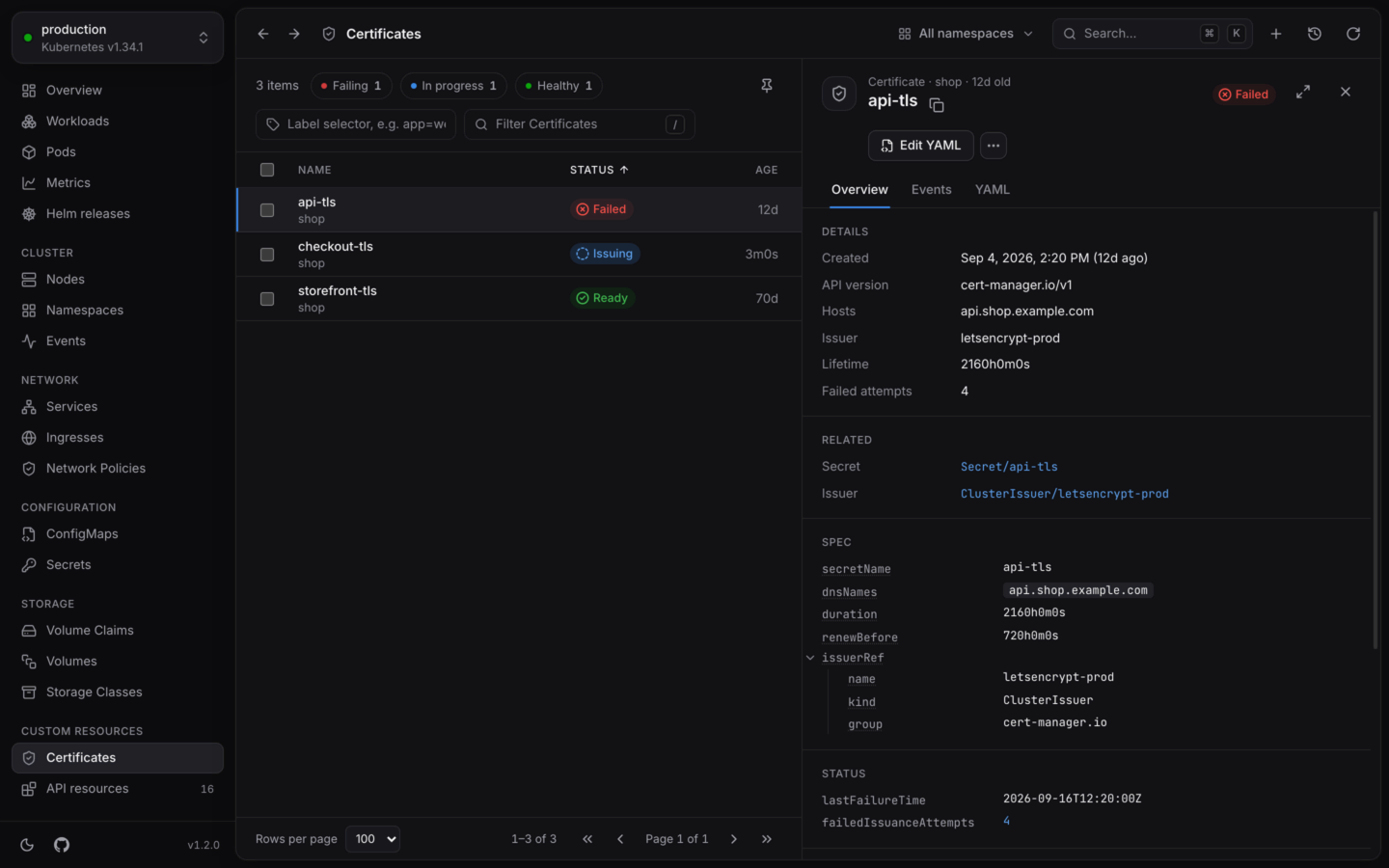
A cert-manager certificate, shown with KubeStacks' view of it.
Finding a kind
API resources
Every kind, like
kubectl api-resources. In the sidebar, at the bottom.The sidebar
The kinds you opened last in this cluster, and the ones you pinned.
Command palette
⌘K finds any kind by name, short name or group.
API resources
API resources lists every kind the cluster serves in two tables: Custom resources, grouped by API group, and Kubernetes. For each kind you see its short names, API version, Scope (namespaced or cluster-wide) and which View it uses, if any. Filter kinds matches names, short names, plurals and groups.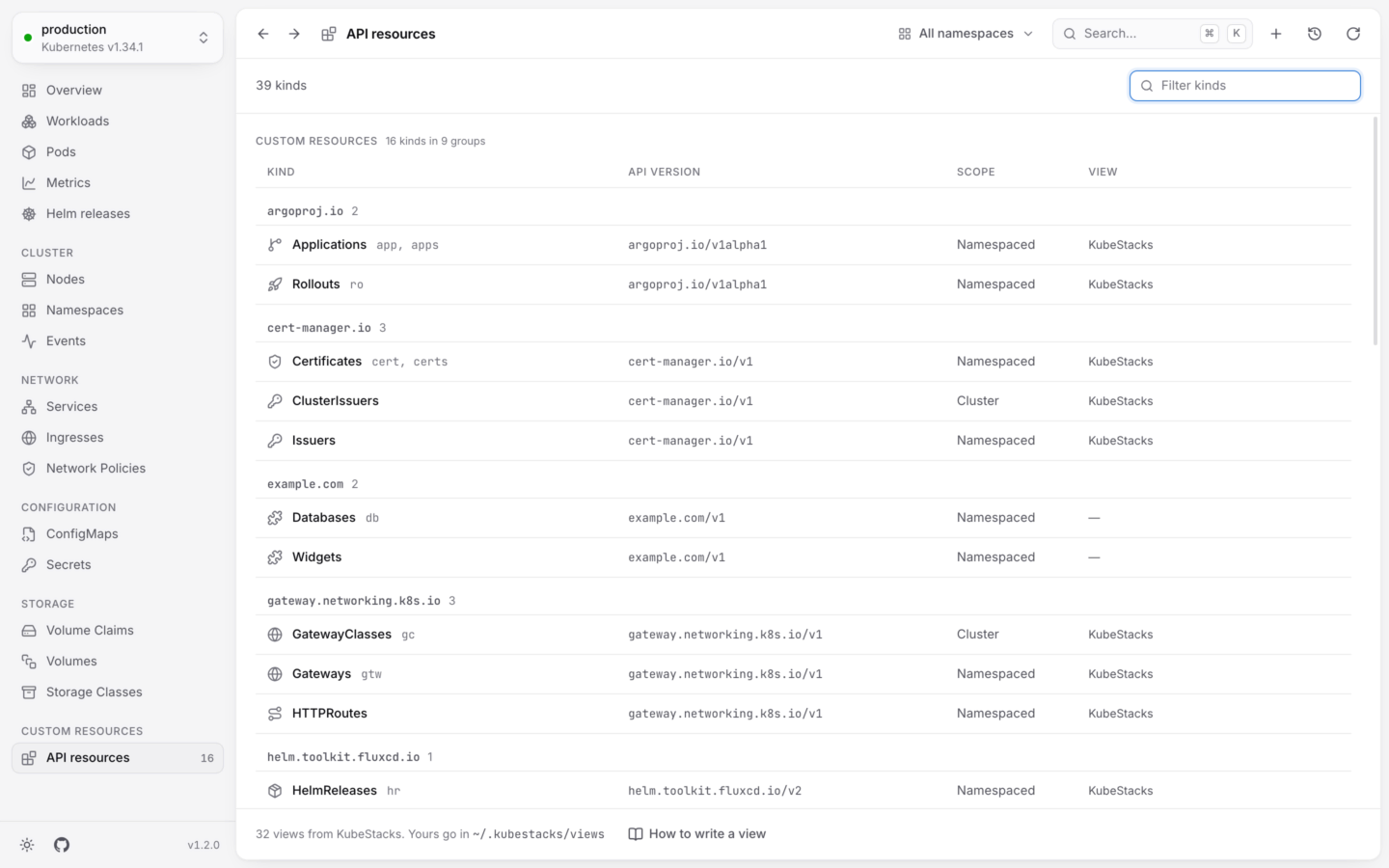
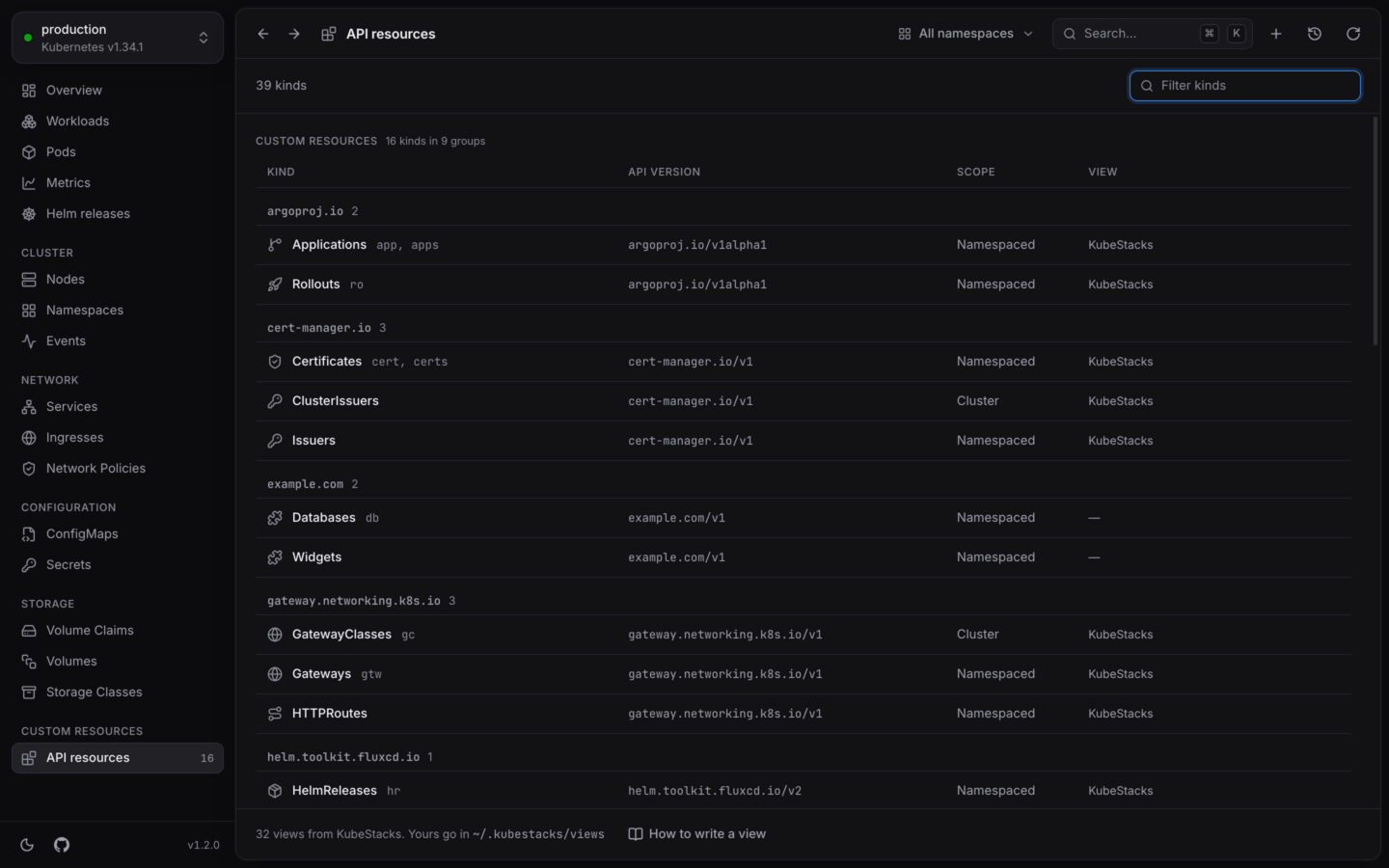
Every kind the cluster serves, custom resources included.
A short sidebar, however many CRDs
A cluster can have hundreds of custom resource definitions, so the sidebar doesn’t list them all. Its Custom resources section keeps the five kinds you opened most recently in this cluster, and API resources with a count of the rest. To keep a kind at hand, pin it: use the pin button on its list, or next to it in API resources. Pinned kinds get a Pinned section in the sidebar, in every cluster that serves them.What you see
Columns
A kind’s list has the columns the API server prints for it, the same oneskubectl get shows (a CRD’s printer columns). A view can replace them with better ones.
Status
Each object gets a status read from the conventions most controllers follow, checked in this order:1
Being deleted
Terminating
2
Turned off
spec.suspend gives Suspended, and spec.paused gives Paused.3
Stuck
A
Stalled condition that’s True (as kstatus defines it) is critical, labeled with its reason.4
Its main condition
The first of
Ready, Available, Healthy, Programmed, Established, Succeeded or Accepted that it has. False is critical (unless the object says it’s still working on it), and True is healthy.5
Catching up
A
Reconciling condition, or a spec the controller hasn’t caught up with yet (status.observedGeneration behind metadata.generation), is Reconciling.6
A health or a phase
Failing that, an Argo-style
status.health.status, or status.phase or status.state, read by its words: “Failed” or “Degraded” are critical, “Pending” or “Provisioning” are progressing, “Running” or “Bound” are healthy, and so on.The detail panel
Click an object to open it. Its Overview has its details, its conditions, the objects it’s related to (when a view says), and its Spec and Status as trees you can fold. On Kubernetes 1.27 and later, KubeStacks reads each kind’s schema from the cluster’s OpenAPI documents, and explains every field when you hover it. Custom resources publish their CRD’s schema there too, so their fields are explained the same way.What you can do
Custom resources are first-class:- Create them from YAML (⌘N), checked by the cluster before anything is created. The cluster has to serve a kind before you can create objects of it, so create a new CRD on its own first. See Create from YAML.
- Edit their YAML or labels. Edits are validated by the cluster against the CRD’s schema with a dry run, and shown as a diff before they’re saved. See Edit YAML.
- Delete them, one or many at once. Deleting a CustomResourceDefinition asks you to type its name first, since it deletes every object of that kind.
- Scale kinds that have the scale subresource, like Argo Rollouts, the same way as a Deployment.
- Use the actions a view adds, like Flux’s Reconcile or Argo CD’s Sync.
kubectl command, written like kubectl delete certificate.cert-manager.io/api-tls -n shop --context production.
Views
A view tells KubeStacks more about a kind: which columns matter, how to tell whether an object is healthy, which facts to show, which objects it relates to, and which changes people make to it. Views are YAML and data only, so they can’t run code. KubeStacks ships views for popular projects, and you can write your own. API resources shows which view each kind uses, and lists any problem with your views at the top: a view with a problem isn’t used at all, and the message says where it is.Built-in views
cert-manager, Argo CD, Flux, Gateway API, Karpenter, KEDA and more.
Write a view
Better columns, status and actions for your own kinds, in a few lines.